On one of my first days in Denmark Majken and I picked dome elderflowers and boiled hem down with water, lemon, and sugar to make a sort of syrup (right). Johan looked up a translation for the Danish word for this, and the closest English word is juice. You mix it with about three times as much water to dilute it. On the left is elderflower juice that is often served upon order at restaurants.
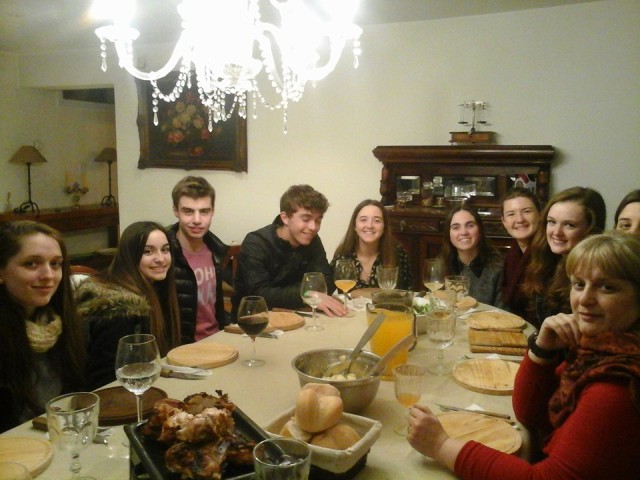
I made dinner one night for my host family. They asked for me to make an “American meal”. I asked what they considered American food, and all they could come up with was fast food and casseroles, neither of which we eat much of in my house. Instead, I decided on caprese chicken and roasted zucchini.
We ate a lot of ice cream in Denmark. It was pretty common to go for ice cream during the day or after dinner. In the left picture, there is a schokokuss, chocolate kiss, on the ice cream. It is a danish desert made of whipped egg whites and chocolate.
As for non Danish food, we ate out a few times. On the left is a risotto dish I had at an Italian restaurant one night while sailing. On the right is a photo of a pizza-sandwich type thing. I probably took too many pictures of this thing just to show my dad when I got home.
lunch is a pretty routine meal. It often consists of smørrebrød with cold cuts, vegetables, remoulade, and other assorted toppings. we usually ate open faced sandwiches, but since we were hiking when I took this picture, we packed ours double sided.
The candy in Denmark and other Scandinavian countries is quite different from what you see in the rest of the world. A lot of it contains lakris (licorice) which is typically much stronger in taste than what you find in the U.S. Other candies have chocolate or mint on the inside of a coating.
We went out for brunch one Sunday, and it was enormous. The brunch at this restaurant included eggs, bacon, yogurt, crepes, salad, bread, cheese, and smoked salmon. I didn’t get anywhere close to finishing all of it, but it was delicious and beautiful.
As a contrast to all of the delicious foods above, here is a photo of a ancient viking home replicated at the ruins of the kingdom of king Bluetooth. Fun fact: the bluetooth symbol we see on our iPhones is the symbol belonging to the viking king. You can see how the vikings cooked their meals: in a large cauldron, over an open fire.
Topic: How people treat an American exchange student
Yanqui (n): an American in Argentina, especially one with light skin, hair, and eyes
In other words, I am the definition of a Yanqui. People here use this word to describe me and the two other American exchange students. It used to bother me because I don’t live anywhere near the New York Yankees, but I’ve grown to embrace the title. It sets me apart and reminds me that I’m a little different here.
Everyone I meet is kind and welcoming to the utmost. They come right to me and ask questions about my exchange. The top three are:
“Hasta cuando quedas?” (How long are you staying for?)
“De donde sos?” (Where are you from?)
“No estas aburrido en Daireaux? Es muy chiquito.” (You’re not bored in Daireaux? It’s very small.)
Of course, I answer no to that last question!
In Daireaux, there’s no hiding my foreignness. Like Hood River, everyone knows everyone here. So I definitely stand out, especially since I look and speak differently. I don’t mind it in the least, and I’ve never felt like people are unhappy to have me here.
When I first arrived in Argentina, I avoided talking about America because I thought it would detract from experiencing the culture here. Partly true, and partly not. I’ve learned that there are a lot of times when it’t best to just soak everything up and live in the present, but there are also times when it’s intriguing to converse with people about the differences between the US and Argentina. I’ve figured out that it’s okay to embrace being an “extranjero.”
My classmates here are incredibly kind and I’m so grateful for them. Since the beginning they’ve made me feel welcome and part of this lovely community.
Only nine days left in Argentina, and I’m trying to live it up as much as I can!
First of all, I apologize for the lateness of this post. I have been very busy showing Majken my home and have been extremely tired since I got home.
Topic: how you’re treated as an American exchange student
While in Denmark, I found that I was treated differently as an exchange student. It was pretty obvious that I would be treated differently than I am at home in the US, but this was a different reception than I had ever experienced. I have seen other countries as a tourist with my family, with my classmates and teachers, and with a group of people I had never met , but being on exchange is a very different situation altogether
As a tourist with a large group, you only see what the schedule has outlined. Though this provides experiences you may not have had traveling alone or with family, schedules leave very little room for adjustment or time to explore as you wish.
As someone who lives in a town that receives a lot of tourists in the summer, I don’t always love having them around. I understand that they are an important part of our economy, but on the other hand, they are quite irritating.
On my exchange I never felt like an obnoxious tourist, even when I was out and about without my host family. They were full of fun facts about every place we visited. I learned so much about the Danish culture from my host family that I may not have learned while seeing the country on my own or with a tourist group.
I’ve experienced a similar reception only one other time. This was when I was in Costa Rica volunteering in a rural area on a cultural reserve. MY fellow volunteers and I felt more like members of the community than tourists. What made the difference was that for counselor was a native of the area. He had the trust of the community and therefor they trusted us, the Americans. We truly felt like part of the community as we played soccer in the mud and danced around with the local children.
Everyone seems to be trying to travel like a local. The phrase in itself is a bit contradictory if you think about it;however, there seem to be about a million articles online about just how to do it. The one tip they are missing is to be with a local. It makes all the difference when you aren’t surrounded by tourists or wandering around looking lost and confused. If you look like a local you’re treated like one.
I was treated like a friend or family member while on exchange. When I was with Majken’s friends or friends of the family, I felt at ease just like I was with friends back home. As an exchange student, the feeling of being out of place goes away almost completely, which is all that you an ask for. One thing that separated me from a group at any time was the language, but even then, people were very kind in trying to speak English around me.
Politics were another part of being an American that I felt separated me. I was often asked about our current political situation, which I answered honestly. I always felt the need to disclose my stance on many issues because I didn’t want to be grouped with the less favorable side of our current political situation. America is currently pretty messed up politically, in my opinion, and it is kind of uncomfortable to be talking about politics with people in another country simply because it is kind of embarrassing that things have gotten too out of hand in so many ways for the United States. Its hard not to talk about it, really. In fact, I found myself realizing, even more than I already had, how awful our country must seem right now. (I hope to write a political comparison of Denmark to the US soon)
Overall, I found that I was never very worried about being the American on the street, but sometimes a bit nervous to be the American in the room.
Un post en español, para practicar. Disfruta, y perdón si no entiendes mi español, jaja.
Ayer, fui al campo de un amiga de Pato, el presidente del rotary aca. La amiga, que se llama Ana Roca, es un descendiente de Julio Roca, y este hombre era un presidente de Argentina empezando en 1880. El tenia una estancia muy cerca del pueblo Daireaux, y ahora, Ana Roca es la dueña de la estancia.
Fui en auto con Pato, su hija Manuela, y su intercambio de Italia, Greta. Cuando llegamos al campo de Ana, exploramos la casa, y todos los antiguas adentro. Había muchas cuadros de arte como las tres mujeres en sombreros debajo. También, pinturas de la familia Roca. Había monedas antiguas de la era cuando la Republica de Argentina se fundó. Estos me interesan mucho. Son pesadas y hecho de plata o de otras metales caros. En la casa había la montura del Julio Roca para sus batalles. Esto también, hecho de plata.
Después del explorando la casa, comemos un almuerzo con Ana. Comemos pizza. Ahora yo entiendo que la pizza es la comida mas popular del mundo. La gente comen pizza en Argentina, en Italia, y en los Estados Unidos, y nosotros hablamos sobre los diferencias de las pizzas de países diferentes. En Argentina, siempre comemos pizza con aceitunas verdes, y de los sabores diferentes de pizza, unos de lo mas popular son jamón y huevo. Greta dijo que la pizza de Italia es es distinto.
Luego, después de un té de hierbas, ponemos las camperas, gorras, y bufandas, y fuimos afuera para… andar en caballo! Matias, el hijo de Ana, eligió un caballo manso para mi. Era un mujer, no muy alta y con una cara simpática. Lo mas tranquila de todos. Matias puse la montura y los estribos, y finalmente, yo pude montar en caballo. Anduve primer, y Ana, Manuela, y Greta siguieron en un carro detrás de otro caballo, para un vuelta de la propiedad de la familia Roca.
En los campos, no hay sierras para proteger de los vientos, y por eso, hace mucho frío. Mas, siempre hay humedad como una niebla re frío. Pero… me siente nada de eso. Mi caballo era rápida y bien entrenado y por eso me alegro. Pasamos afuera del La Benicia en la calle de tierra en el dirección de La Larga, un pueblito cerca de la propiedad.
Era muy feliz porque tuvo la oportunidad de visitar estos lugares que son parte de la historia de Argentina. Era un experiencia autentica y especial por un intercambio.
DISCLAIMER: this was written 10 days ago but I was having some technical difficulties with uploading photos… Enjoy!
As I mentioned, I went sailing for about a week with my host family at the end of my exchange. Though it didn’t go exactly as planned, I wouldn’t have had it any other way.
Granaten (Grenade)
We began our trip by sailing from Kalundborg to Kateminde. We walked in the pouring rain to a little Italian restaurant for dinner, and despite the fact that our clothes we’re still wet by the end of dinner and we were all still pretty cold, we went for ice cream anyways.
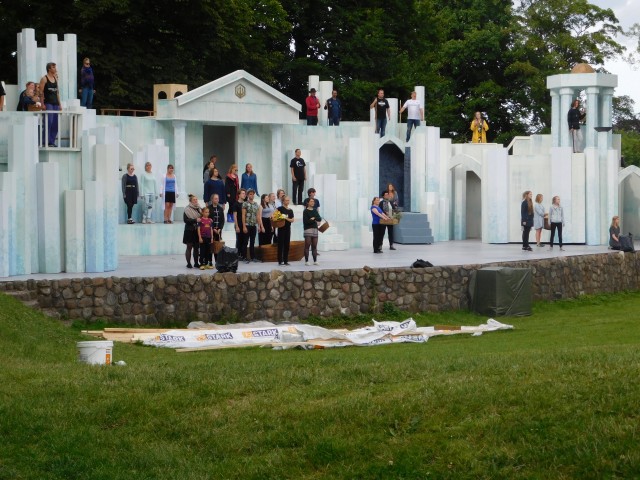
The next morning, we sailed on to NyBbrg. We went on a walk around the town and stumbled into rehearsal for a musical along the way. We had been planning on making dinner on the boat, but as we were heading back to the harbor, we decided to stop for some sushi instead.
musical rehearsal
Our third day of sailing began as any other. We had sailed almost all the way to Svendborg with just a few more miles up the fjord to the marina when things took a turn. We were about to take down the sails and motor the rest of the way to Svendborg, but when Christian tried to are put he motor, the propellers wouldn’t move. We quickly turned around to allow for more time to problem solve, and after many tries to restart the engine, we realized that it may need serious repairs. With careful contemplation, we decided that our best option would be to sail through the night back to Kalundborg. At around six o’clock, the wind completely died. We were just floating in the ocean just before the suspension bridge between the islands. This was when we realized that it would be a long trip home. Finally, after dinner, the wind began to rise just a little. enough to keep us moving at roughly 1.5 knots. Our plans had been to final a sports bar in Svendborg to watch the Euro Cup finals, so we improvised. Johan got the game playing on his iPad and we sat outside watching the game, sipping tea and coffee, and taking in the fresh ocean air. By half time. it had begun to rain and we moved inside. Then, we started seeing flashes of lightning in the sky. Everyone was silently counting to see how close it was to us. The game ended and Portugal was victorious. We settled down to sleep while Christian sat watch, as we slowly made our way home.
Christian waiting patiently for the wind
flat waters approaching the bridge
bridge to nowhere
I woke at five in the morning as well were pulling into our slip at the Kalundborg marina. Christian stayed behind to sleep on the boat while the rest of us drove to the house for breakfast and a midmorning nap. When we returned to the boat later that day, we found out that there had been a raincoat stuck in the propellers keeping them from moving. We discussed our options for the next few days and decided to sail over to Samsoe the next morning and spend one final night on the boat there.
The sail over was a bit rough, but when we arrived, the weather was beautiful. We tied up to the end of a row of boat in the crowded harbor and had a nice lunch in the sun. Lisbeth and I went for a very brief swim- the water was even colder than the beach in Kalundborg. We had a lovely dinner at restaurant nearby, played some Uno, and went to bed.
The next day, we left right after breakfast to bike around the island. We returned from riding roughly 40 kilometers and set out for home once again. Our final sail was absolutely stunning: perfect wind, hardly any waves, and the sun was shining. We had one last dinner on the boat before bringing our bags home. Majken and I had ridden our bikes down the marina two days before, so we added some more distance on our ride home to what we had already ridden that morning.
taking a break on our bye tour of Samsoe
On my final day in Denmark, we went downtown to do some shopping for gifts and to run some errands. After that, we spent most of the day packing up our things to fly out early in the morning. Lisbeth made a delicious farewell dinner that night and gave me a gift to remember the family by.
This morning, we dragged ourselves out of bed at 3AM and departed for the airport. We had just enough time to stand in about a million different lines, she of which were the wrong lines, to check in and check our baggage before saying farewell to the family and going on our way. We have been traveling for nearly 20 hours since we left the house and we still have about 5-6 hours to go as we wait patiently in the San Fransisco airport for our final flight to PDX and a 50 minute drive back to Hood River.
I am almost home yet it still seems so far away. I would like to thank my lovely host family once again. You have been so amazing and kind to me, and I will miss each and every one of you dearly. Also,”see you soon” to my family and friends home in Hood River. I have missed you and I can’t wait for you all to meet Majken and help me show her what life is like in “The Hood”.
Winter vacations are underway, and I started them off with my first quinceanera en Argentina. A girl’s fifteenth birthday is a huge deal here, and similar to other latin American countries, it includes a party that family, friends, and basically the entire town can attend. For those that don’t know the quinceanera very well, the party doesn’t start until around 2 or 3 am. We arrived and danced until 7 am. At that time, of all things, they serve hot dogs (here they’re called panchos). To be honest it took a minute to accept that I was eating a hot dog, on a dance floor, in another country, at the usual time I wake up for school. There are certain things you notice when you’re a foreigner.
At la quince: Me, Sofi, and Anika from the US
We called a cab and got home around 8:30 am, then went right to bed only to wake up two hours later and drive to Puán, a neighboring town. We arrived at the house of Ana, Gustavo’s novia, and then went out to climb el templo Mirador Millennium. It’s a huge Christian temple made of stone, with a ramp spiraling the exterior, and inside is an enormous depiction of Jesus. The 360 view from the top was worth the freezing wind and threatening clouds, but we didn’t stay too long.
View from the top of the temple.
Gustavo and Fanny
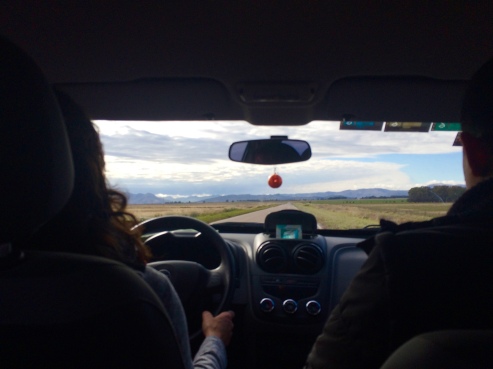
The next morning we packed up and drove to Garganta Olvidada, a popular destination in the Sierra de la Ventania mountain range. On the drive, I tried to understand the lyrics of popular Argentinean songs, which I’m getting better at. I love the music here. Something I’ve noticed: music, food, pictures on Facebook, politics etc are great topics to spend time talking about in castellano. The hardest part for me is the random small talk, but if I can draw the conversation in the direction of my understanding, it’s easier to speak up and practice.
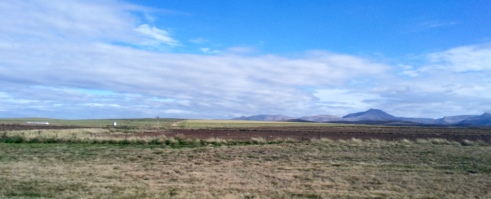
I found the landscape on the drive breathtaking, and a little bit similar to the eastern Columbia Gorge. My family kept making fun of me for looking around so much. And the horses…! They’re gorgeous here, and I can’t wait to get the chance to ride.
We arrived at Garganta Olvidada and Franco, Fanny, Sofi, and I hiked to the waterfall. It was pretty busy, and the area is definitely well known by people that live nearby.
On the way up!
My adorable siblings
Top notch scenery.
The falls
After our hike, we ate lunch, climbed another lookout point called Sierra de los Enamoradas, did some shopping in a nearby town, and went home. A pretty solid day overall!
Franco and Vale at the lookout
Sierra de los Enamorados
I’m not sure what our plans are for the rest of break, but I would love to keep exploring the area, get to know the other exchange students some more, and hopefully get on a horse at some point. And of course… learn more castellano! Thanks for reading this blog, and keep an eye out for more posts to come.
Here’s what I’ve been up to lately, brought to you in photos.
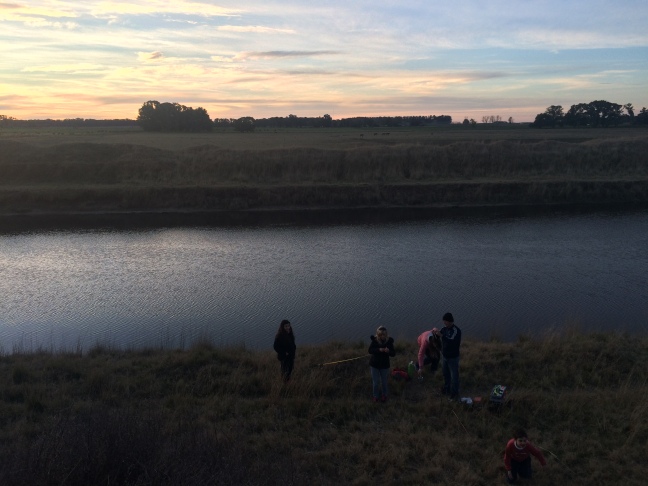
Fishing at the canal with Sonia, Javier, Fanny, Sofi, and Valentino. Outside of Daireaux in the country (los campos), there are lots of places to fish and spend time outdoors. Most of the land is owned by people that live within the town limits, and almost everyone owns some cows and horses.
Trip to Gustavo’s farm to celebrate Argentina’s 200th year of independence. Sofi’s dad raises cattle on his campo, and rents some land to other people to grow crops like wheat and corn.
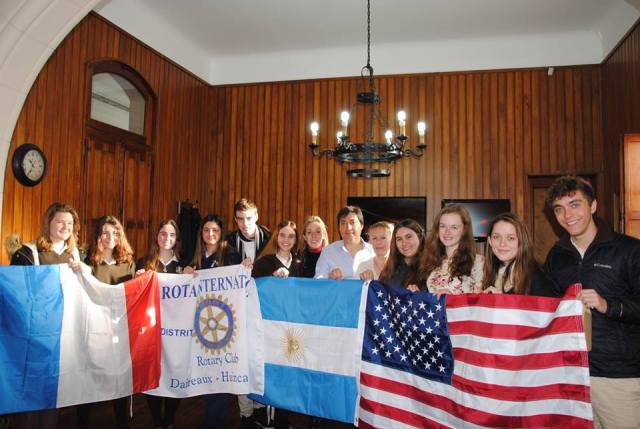
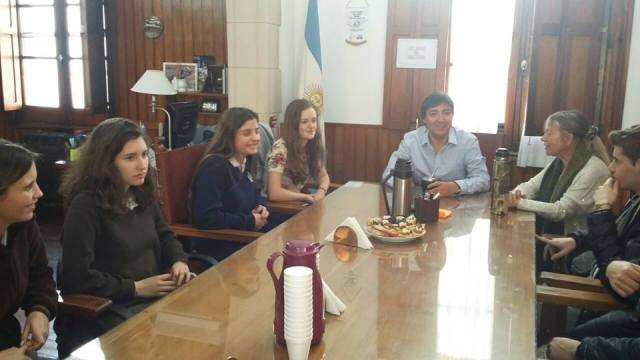
Breakfast with the mayor of Daireaux, Alejandro Acerbo. We had an interesting discussion about world politics! Pictured below are all of the exchangers by their country flag.
Rotary asado cena. An asado is similar to a barbecue in the states, but quite a bit more formal. We ate lechun, an entire small pig.
So that’s what I’ve been up to since my last update. Winter vacations have started, so no school for the next two weeks, and I’m excited to see what this free time brings. Hopefully I’ll explore more of the town and further improve my castellano.
Today marks my third week here in Argentina, and when I think back to my first few days here I realize I’ve definitely came a long way.
The other night at a rotary dinner, Sofi told one of the Argentinian host siblings that she never let’s me speak in English. Never. They were surprised; maybe a little impressed, and it’s true. From the minute I met her at the airport we spoke castellano, all the time. If I slip up and say “okay” instead of “bueno,” she gives me an evil smile and says “Que? No intiendo.” If I don’t know a word, I have to describe it to her in castellano until we figure out what it is. And in school, we resist the urge to have secret English conversations that no one understands, even though that would be like, so fun.
So far, the language barrier has been my primary struggle on my short term exchange. Simple conversations take a lot of brain power, and I’ve realized how much I take for granted communication in general. When I arrived in Argentina, the basic things like buying food and making small talk with people I meet became difficult and at times stressful. Like Kat, the language barrier has taught me to immediately join in conversations, otherwise it’s impossible to follow them. I’m also less afraid to tell people when I don’t understand, and have them repeat things for me or give me a word definition. And if they laugh, I’ve learned to laugh along with them.
That said, there are times when people are speaking too quickly around me to understand, so I feel alone in the crowd. Few people here in Daireaux speak english, and those that do know only basic level conversation because the classes offered in school are insufficient. However, there are exceptions like Sofi that have been taking english lessons with the Rotary president, Pato Pastore for years.
Part of my challenge with the language here is that it’s distinct from the Spanish taught at my school. One difference is that all the “ll” and “y” sounds are pronounced as “sh”, and this makes word recognition more difficult for me. Also, the “you” verb tense is completely different, using “vos” instead of “tú”, and an alternate sense of verb conjugations. I bought a notebook and have been periodically writing words I don’t know and practicing my verb tenses, which helps a lot. My friends and family here are all every supportive and helpful with my learning, which I’m grateful for.
At the same rotary dinner, I had a long conversation in castellano with one of the French exchange students. She speaks little english and I speak no French, but we both learned a ton about each other’s culture in a short amount of time because of our shared spanish. In this case, there was no language barrier, but a language bridge, and it’s times like this that remind me why I’m on exchange.
There are a lot of factors that go into learning a new language, but most importantly, you need time. Since I’m here for such a short time, learning the language has been very difficult. I have been very lucky to have a family that makes a point to speak in English with me because they understand that I don’t have much time to learn Danish.
Before I left for exchange, I did my best to learn some Danish on a free program called Duolingo. In my limited free time at lunch or between classes, I popped my headphones in and tried to absorb all of the Danish I possibly could. Learning a language on an online program leaves very little wiggle room. This particular program began with teaching simple vocabulary and working towards forming sentences with that vocabulary. As I began with Duolingo, I realized that whatever knowledge I retained from this was not going to be very useful. With few other options of learning Danish leading up to my trip, I forged on. Though it may be surprising, I have had no opportunities to use sentences like,”The bear reads a newspaper” or “Turtles are eating potatoes.” in Danish.
Since I’ve been here, my family has been teaching me more useful words and phrases like “tak” (thank you) and “godnat” (goodnight). I have also found that if they are watching TV in English, I can learn more words by reading the Danish subtitles while listening to the English being spoken. Written danish looks quite similar to English and has similar grammatical patterns. While on buses or trains, I try to read signs and translate the from Danish to English. Having context is always really helpful, so I can often figure out what a sign says just by knowing that it has to do with train travel. What I struggle with the most in learning Danish is the pronunciation. When people speak in Danish, they speak incredibly fast and words are pronounced much differently than they would be in English based on the written words. When I first heard people speaking Danish, it sounded like complete gibberish to me. Now, when I listen to Danish, it sounds more like a language, and I can recognize a few words here and there, allowing me to at least figure out the topic of conversation some of the time.
Still, if you asked me to speak in Danish, I wouldn’t be able to hold a conversation or form a useful sentence. Sometimes, I think about how I would say a certain sentence in Danish, and when I don’t know certain words, I end up using Spanish or English words. So, I obviously have a long way to go in becoming anything close to functional when speaking Danish.
So far, I have not encountered a single Dane who didn’t speak at least a little bit of English. Since English is such a global language, it is taught all over Denmark. Sometimes it is hard to start talking to people in English because they don’t often use it outside of school. I have found that it is especially hard to find students to speak to in English because even though they are nearly fluent, it feels a little bit like school to them. As they get more comfortable around me, they realize that I won’t judge them if they don’t know a certain word or if their grammar isn’t perfect. I often have to explain that I am just thankful that they speak any English because I have had such a short time to learn Danish with limited resources.
Though my language skills have only improved mildly, I have become much more aware of language and what its like to be on the side of a language barrier where I don’t understand the language. Along with learning what its like to be outside of a conversation, I have had to learn how to be more engaging and start more conversations myself rather than just entering other ones. For a while, I had trouble with this and it was very difficult emotionally to be so alone in a room full of people. After a few days of this, I realized that I didn’t have to be so upset about people not talking to me, and I started talking to them. I asked about school, traveling, and even started with silly ice breakers like favorite movies.
Another part of not understanding every situation is that you pay a lot more attention to whats around you. I have become much more observant of emotion through body language and inflection. This makes things very entertaining when you can see how everyone is feeling but not what its about. I have also gotten used to really looking at my surroundings and taking in every little detail of a place. In all honesty, its been quite nice to allow my mind to wander and really contemplate things without having to worry about losing track of the current conversation because I probably lost track of it soon after it started.
Though I haven’t been learning a whole lot of language here in Denmark, I think I have learned many more important lessons. I had never realized how much I take communication for granted until it wasn’t a given in my daily life.
By now I’ve started to realize that the United States is the odd-one-out when it comes to popular culture. Argentina and Denmark share a remarkable amount of similarities in the fields of music, TV, and sports.
Like Denmark, futbol is everything in Argentina. On my first night in Daireaux, Sofi and I went to her friends house to watch Argentina play in the American Cup Finals. When we lost tragically to Chile on penalties, everyone in the room yelled in agony, and the remainder of the night was downright depressing. This is the second year in a row that Argentina has lost the American Cup Finals.
The drama escalated the following day when Lionel Messi announced he would be leaving the Argentinian national team. Messi is known as “the best soccer player in the world” and has scored 55 goals for the country. But he was also one of the team members that missed a penalty kick in the Copa Americana. Argentina, including my host family, was in turmoil when he announced he’d be leaving the team, but there is still hope that he will change his mind and continue playing for the country. It’s been a difficult time for all the futbol fans, but I’m sure we’ll make it through.
#NoTeVayasLio !!!! (Don’t go Lio)
TV is an important part of the Argentinian day and as I write this, we’re watching Disney Channel in Spanish. When my family sits down at the table to watch TV and eat, there are three main options, none of which I fully understand.
The first, Bailando Por Un Sueño, is the Argentinian version of Dancing with the Stars, but with more humor and provocative dancing. It’s also more elaborate than Dancing With the Stars Another popular show is Morfi Telefe. From what I can tell, it’s a combination of a cooking show with a newscast, where guests are invited to a cena to talk about politics. Morfi is a news reporter that investigated the doings of the past presidents of Argentina, so it’s certainly possible that his news is bias. I’ll write about Argentinian politics in a few weeks when I know a little more, because it’s quite complicated. The third show we watch religiously is the novela Los Ricos No Piden Permiso. It’s plot consists of a lot of rich people living in a mansion and doing scandalous things. Until today, I thought it was called “Este Noche” but that just means it’s going to be on tonight.
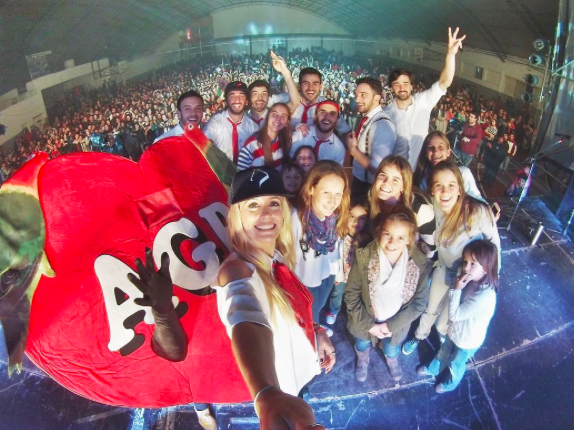
Finally, I’ll talk about some Argentinian music, since last night I went to my first concert here. The type of music specific to the country is called Cumbia, and there are many different types, including pop and electronic. I don’t fully understand, but I believe that pre existing songs can be turned “cumbia” with a certain beat. Last night we went to the town gymnasium for an Agapornis concert. I can’t lie; the audience was 90 percent pre teen girls, but I had a great time nonetheless.
Agapornis in Daireaux on Friday
We listen to music constantly when hanging out with friends. Some other popular bands are Vas, Rombai, Puerko Fino, Bajan, and Mano Arriba. My favorite song here is called Chica Enamorada by Puerko Fino.
That’s all for now, and I’ll have an update about the last few days up soon!